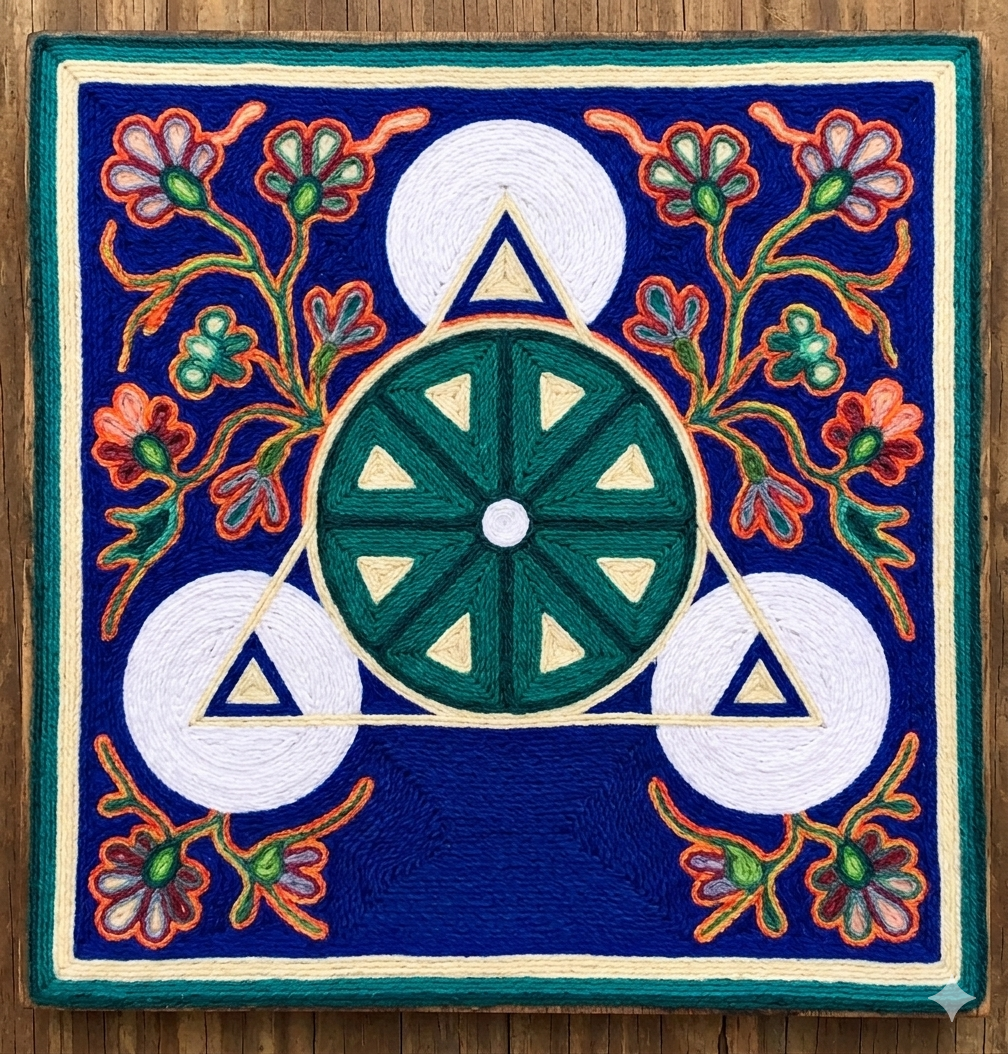
The Irreducible Trinity
At the heart of this Gestalt is the "Peyote-Deer-Maize" trinity. In Gestalt terms, these are not three separate symbols but a "fluid complex" where the meaning of one is entirely dependent on its relationship to the others. The deer represents the guiding unconscious, the maize represents physical survival, and the peyote acts as the "transcendent bridge". To remove one element would be to collapse the entire psychological "map" that integrates the Wixárika’s historical, agricultural, and spiritual dimensions.
This symbolic fluidity is so profound that the Wixárika perceive these elements as interchangeable: maize is viewed as the "blood of the deer," and peyote is considered "powder from the deer's antlers". This "radical interconnectedness" suggests a psychological state where the individual does not exist in isolation, but as a "relational entity" embedded in the context of family, culture, and nature. The "whole" here is the entire ecological and spiritual web, and any disruption to one part is felt by the entire system.
Figure-Ground Dynamics in Perception
Gestalt psychology famously explores "figure-ground" relationships—how we focus on a specific object (the figure) against its background (the ground). In the context of the peyote ritual, we see a dramatic shift in these dynamics. Neuropsychologically, the ingestion of mescaline induces a "hyper-frontal" pattern of brain activity, particularly in the right hemisphere. This shifts the practitioner’s focus from external, secular "ground" stimuli to intense internal visions and "emotional heightening," which become the new primary "figure" of awareness.
This shift is not just visual but social. The Western world often fixates on the "Lizard King" persona or "shamanic alter egos," making these the "figure" of Wixárika culture. However, this "hypervisibility" often obscures the "ground" of the people’s actual struggles, such as land encroachment and mining. A true Gestalt view requires us to look past the "exotic" sensory data to see the "transcendental meaning" and the cultural milieus that provide the necessary context for the experience.
The Nierika as a Mandala of Wholeness
The nierika serves as the ultimate Gestalt symbol of the Self. Manifesting as a physical disk or a visionary threshold, it acts as a "mandala" representing the striving for psychic wholeness. By staring into the center of this mandala, the practitioner is able to see beyond the "veil of ordinary reality" to communicate with ancestors and diagnose social or spiritual discord. It is a tool for "integration," allowing the mara'akame to perceive the totality of a person’s spirit rather than just isolated symptoms.
Ritual Synthesis and Communitas
The actual collection of the peyote is ritualized as a "hunt," a synthesis that "binds together the deer, the maize, and the peyote". When the mara'akame "stalks" the cactus as if it were a deer, he is performing a ritual act that reinforces the "continuity of life on all its historical, cultural, and religious levels". This is not a series of disparate actions, but a single, disciplined operation designed to maintain the "psychospiritual architecture" of the community.
Socially, this ritual produces "communitas"—a sacred modality of relationship where participants feel a "profound sense of equality and unity". This state of "anti-structure" allows the community to periodically shed the "cultural trap of excessive societal structure," which can lead to stagnation. The shared vision and pilgrimage reinforce group identity, creating a "social revitalization" that empowers the community to stand as a unified whole against external threats.
Ecological Interconnectedness
The Wixárika "ecological web" is reflected in their art, which is saturated with symbols like the eagle, snake, and wolf. These are not merely decorative motifs but "points of contact between God and man," representing different psychological and ritual functions within the cosmic whole. For example, the eagle represents "divine vision," while the snake symbolizes the "cycle of renewal". Each animal is a vital component of the "psycho-ecological web" that supports Wixárika identity.
Even the modern inclusion of a "Coke truck" in yarn paintings is a significant psychological marker. It represents the "acculturative process" where the ancient symbolic system must now integrate modern globalized elements. This demonstrates the "resilience" of the Wixárika Gestalt; rather than breaking under the pressure of the modern world, the system attempts to absorb and negotiate these new elements while maintaining its core "equilibrium".
Healing as Restoration of the Whole
In this framework, "healing" is redefined. It is not just the alleviation of individual symptoms but the "restoration of equilibrium within the broader interdependent system of the cosmos". The mara'akame acts as a "spiritual doctor" who involves the patient’s spirit, the community, and the gods in the process. This holistic approach recognizes that "caring for the spirit was just as important as caring for the body".
The "afterglow" following the ceremony is the phase of "psychospiritual integration". During this time, the "exotic" sensory data of the vision is worked through to find "transcendental meaning" that can be applied to daily life. This effectively turns a temporary "altered state" into a permanent "altered trait," allowing the practitioner to maintain spiritual clarity and mental relief long after the ritual has ended.
Conclusion: The Integrated Psyche
Ultimately, the Wixárika model suggests that the "integration of the biological, the symbolic, and the communal" is the key to psychological resilience. By viewing the world as a radical Gestalt, they avoid the fragmentation common in the "secular, over-rigid modern world". Protecting the sacred landscape of Wirikuta is therefore a "psychological imperative," as it is the "axis mundi" that supports the entire community's sense of place and well-being.
Does this holistic way of seeing the world—where every plant, animal, and ritual is a vital part of a single, living whole—change how you perceive the connection between your own environment and your mental well-being?